A4 Purple Overlay
 |
Make print clearer.
Reduce glare. Support comfortable reading.
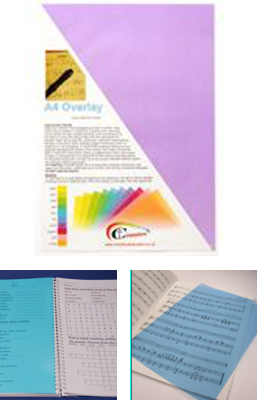
A4 Coloured Overlays are
designed to make printed text easier and more
comfortable to read for children and adults who
experience text related visual discomfort or
reading difficulties. They are intended as an
accessibility adjustment, not a reading
intervention.
The full A4 size allows
the entire page to be viewed at once, making these
overlays particularly useful for worksheets,
information sheets, music notation, and extended
texts. They may also be easier to handle than
smaller reading rulers for younger children, older
students, or individuals with coordination
difficulties. Overlays can be cut in half for use
with smaller pages.
|
*Please note the colour shown in the picture may not be an exact representation of the colour in real life.
Designed for clarity and comfort.
- Matt finish on one side
to reduce glare and reflected light.
- Gloss finish on the reverse
for those who prefer it.
- Maintains print clarity while
improving visual comfort.
Research
by Apple and Microsoft has influenced the inclusion of coloured
tints as accessibility features in tools such as iPads,
iPhones, and Microsoft Immersive Reader, highlighting their
value for reading accessibility.
How coloured overlays may help
Some
children and adults experience text-related visual
discomfort when viewing high-contrast, repetitive
patterns, such as black text on a white background. This
can include glare, eye strain, headaches, or text appearing
blurred, unstable, or difficult to look at for long periods.
For a some people, placing a
coloured overlay over the page can:
- Reduce visual discomfort or
glare.
- Make text feel easier to look
at.
- Help with reading stamina or
tolerance.
Who might find overlays useful?
Coloured overlays may be helpful
for:
- Children or adults who complain
of eye strain or headaches when reading.
- People who find high contrast
print uncomfortable.
- Readers who say text looks too
bright, shimmery, or hard to focus on
- Readers who experience fatigue
when reading.
Coloured overlays: what they can
(and cannot) do
Dyslexia is a lifelong
difference in how the brain processes written language. It
cannot be cured, and coloured overlays do not treat
dyslexia or change core reading skills such as decoding,
spelling, or phonics.
Coloured
overlays are best understood as a comfort and accessibility
support, not a cure.
Alignment with Australian
education and inclusion frameworks
The use of
coloured overlays as an optional accessibility support aligns
with Australia’s inclusive education obligations under the
Disability Discrimination Act 1992 (DDA) and the
Disability Standards for Education 2005, which require
schools to provide reasonable adjustments so students
with disability can access learning on the same basis as their
peers.
Providing
coloured overlays as a choice-based environmental adjustment
supports students who experience text-related visual
discomfort, helping to reduce barriers to accessing printed
materials. This approach is consistent with the principles of
Universal Design for Learning (UDL), which encourage
flexible options for how information is presented to meet
diverse sensory and perceptual
needs.
Coloured
overlays are not a treatment for dyslexia and do not replace
evidence-based literacy instruction. Instead, they may be
offered as a low-cost, non-invasive adjustment to
improve visual comfort and engagement for a subset of learners,
alongside appropriate teaching, intervention, and support.